

The Respiratory Care Interstate Compact (RCIC) is about one simple idea:
Make it easier for respiratory therapists to work where patients need them—without unnecessary barriers.


Advertisement
 Sign In
 Search


The Respiratory Care Interstate Compact (RCIC) is about one simple idea:
Make it easier for respiratory therapists to work where patients need them—without unnecessary barriers.


Right now, respiratory therapists have to get a separate license for every state they want to work in. This includes respiratory therapists doing telehealth. That takes time, money, and paperwork.
The RCIC fixes that by creating a simpler way to work across state lines, which:
In short: fewer barriers for therapists = better access for patients.
In simple terms: AARC built the roadmap and helped states bring it to life.
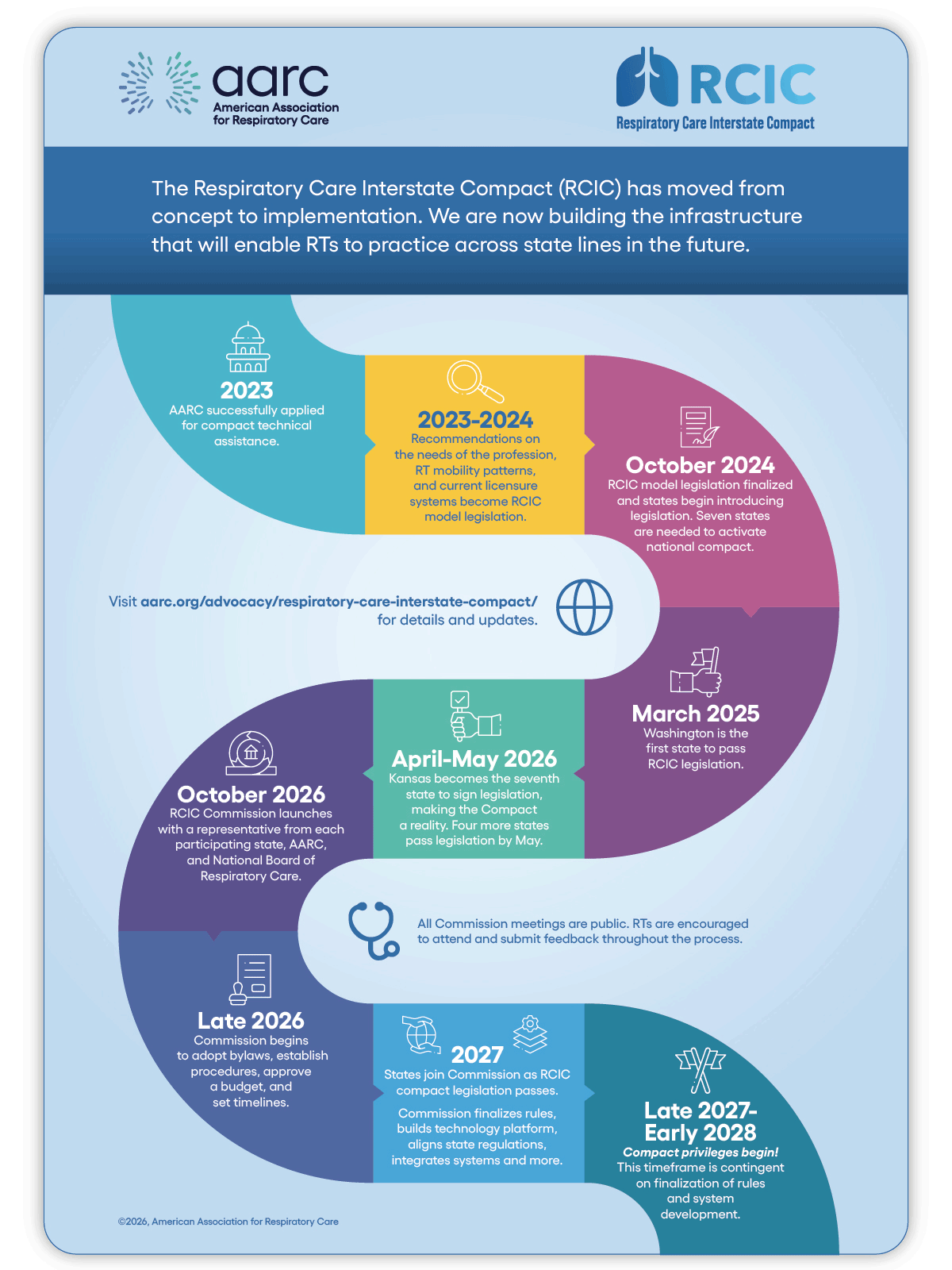
Now that the “activation threshold” has been passed the next steps include:
This setup phase typically takes about 2–3 years after the threshold is reached. The earliest RTs may be able to obtain compact privileges would be late 2027.
The timeline for applying for a compact license will not be immediate. You’ll be able to apply after the Commission is fully set up and operational systems are built which could take 2-3 years.
Think of it like this:
Yes—for now.
Over time, many therapists may choose to drop extra licenses and rely on compact privileges instead – depending on how many states pass the legislation.
Yes—that’s exactly what the compact is designed for.
As long as:
You can apply for permission (“compact privilege”) to work in other participating states
Commissioners are not elected by individuals.
Each state appoints:
So, Commissioners are typically state regulatory leaders, not individual RTs.
It depends on your primary state of residence (your “home state”).
The compact is based on your home state license, not just any license you hold.
You can help bring it to your state by:
AARC provides advocacy tools and guidance to help states pass the legislation. If you are interested in getting involved, please email us at membermail@aarc.org.
Advertisement