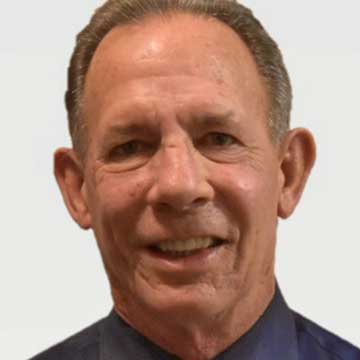
Director-at-Large
John Blewett, MA, RRT, FAARC
Public Reporting Coordinator (Quality Outcomes Department)
University of New Mexico Hospital
4 years as RT department director
25+ years in RT education including
20+ years providing direct RT patient care
AARC Member Since 1985
AARC Activities:
- Chair, AARC Elections Committee 2005
- Member, AARC Elections Committee, October 2002 to December 2004
HOD Activities:
- Senior Delegate, New Mexico Society for Respiratory Care December 2000 to December 2002, and December 2004 to December, 2006 and January 2022 to January 2024. Junior Delegate January, 1999 to December, 2000 and January, 2020 to January 2022, and January 2024-present
- Co-Chair, HOD Disaster Relief Ad Hoc Committee, Nov 2024-present
- Co-Chair, HOD Ad Hoc Committee on Affiliate Pandemic Impact 2020, 2021
- Chair, AARC HOD Chartered Affiliates Committee 2002
- Member, HOD Student Mentorship Committee 2021-present
- Member HOD Chartered Affiliates Committee 2021-present
- Member, AARC HOD Progress and Transition Committee 2002
- Member, AARC HOD Publications Committee 1999 and 2000, Chair 2005-2006
- AARC Delegate of the Year Award 2002
Affiliate Activities:
- President-elect/President/Immediate Past President, New Mexico Society for Respiratory Care, 1996 to 1999
- Treasurer, NMSRC 1995–1996, NMSRC, and January 2016 to January 2020
- Program Committee Chair 1995, 1999 and 2024
- Have served on the NMSRC program committee continuously since 1991: chaired several sub-committees including education, sputum bowl, golf tournament and awards.
- Parliamentarian, NMSRC 2006–2012
- AARC Outstanding Affiliate Contributor Award, December 2007
Related Organizations:
- Member, Board of Directors and Communications Chair, Albuquerque Quality Network (AQN), December 2017 to present
- Member, American Lung Association of New Mexico (ALANM) Board of Directors, August 1997 to June 1999
- Advisory Committee for ALA Arizona/New Mexico June 1999–2000
Education and Credentials:
- Master of Arts in Educational Leadership (Leadership for Community and Organizational Learning Concentration) University of New Mexico 2009
- Bachelor of University Studies University of New Mexico 1993 (Magna Cum Laude [General Honors], Distinction)
- Associate of Science in Respiratory Therapy, University of Albuquerque 1986
Publications:
- Pearce E, Campen MJ, Baca JT, Blewett JP, Femling J, Hanson D, Kraai E, Muttil P, Wolf B, Lauria M, Braude D. Aerosol Generation with Various Approaches to Oxygenation in Healthy Volunteers in the Emergency Department. J Am Coll Emerg Physicians Open. In press, 2021. http://dx.doi.org/10.1002/emp2.12390
- Singh S, Podila S, Pyon G, Blewett J, Jefferson J, McKee R, An analysis of 3,954 cases to determine surgical wound classification accuracy: Does your institution need a Monday morning quarterback?, The American Journal of Surgery (2020), doi:
https://doi.org/10.1016/j.amjsurg.2020.04.017
- Colorectal Infections and Bundle Block: When Bundles Are Not The Answer,
Podium presentation American College of Surgeons Quality and Safety Conference, July 2018. Jones, Lucero. Fiser, Blewett, Kenna, McKee.
Elections Committee Questions:
What do you see as the biggest challenge facing the AARC and what do you recommend addressing it?
According to the Bureau of Labor Statistics, there were about 140,000 licensed RTs in the US in 2024 and AARC membership peaked that year at 42,383 according to the AARC 2024 Annual Report. That is a about a 30.3 percent membership rate nationally which demonstrates the ignorance in our profession related to who we (the AARC) are and what we do for our profession, despite good efforts by the AARC Membership Committee to dispel that ignorance. Strategies to improve that involve having direct conversations with staff respiratory therapists and future respiratory therapists (students and prospective students) by giving more tools and incentives to leadership in respiratory therapy departments and faculty in respiratory therapy programs to boost membership. The AARC Board of Directors needs to consider bringing back the incentive to allow students to have a free membership in the AARC if all of the faculty in their program (including clinical instructors employed by the program) are AARC members.
Health care is changing more rapidly than ever. What ideas do you have to help today’s Respiratory Therapist meet these challenges?
Changes: shift to providing more care in the home for our patients and the ability to provide some of that care remotely using telehealth and remote monitoring devices; preparing RTs for an expansion of our scope of practice up to and including APRT, and becoming more nimble and adaptable to technology that will enable us to work more efficiently in light of staffing shortages that are likely only going to progressively get worse with time. Helping our profession adapt to all of this through our ongoing educational events are critical to advancing the profession and helping RTs navigate this new landscape.
How would you approach optimizing, developing, and implementing value added benefits, programs, and resources within AARC leadership and governance structures to meet the diverse needs of our members while also cultivating a keen sense of belonging and encouraging long term membership?
I addressed membership in my first answer, but in addition to that, it befalls the AARC Board of Directors to guide the AARC Executive Office in the development and optimizing those value-added benefits, programs and resources. To that end, having the different benefits programs and resources clearly tracked and published so the Board has a clear picture of our current state and then can focus on future endeavors is an important piece of our governance structure. With that of course comes a need for strong communication between the Executive Office and the BOD. Cultivating a keen sense of belonging comes with those value-added benefits programs and resources. Encouraging long-term membership is one thing we are already doing well. Once professionals join, they must see value in membership because they stay—according to the 2024 AARC Annual Report, we have about a 90% retention rate which is above national performance for professional organizations.
Your role as Director-at Large is to represent the general AARC membership. If given the opportunity to represent, what will be your goals in advocating for the everyday respiratory care professional?
My main goals are to:
1. Work closely with the AARC Committees, especially our Membership Committee to market the AARC to the RT community and beyond to increase our community and therefore our ability to have more of a voice to the larger healthcare community and the government.
2. Act as a strong liaison between the AARC BOD and the AARC Executive Office, especially helping identify and rectify gaps in our communication out to the general membership and the world especially with our website and processes.
3. Help develop more value-added benefits to joining the profession especially targeted to the heart of our profession, our staff therapists providing direct patient care.