







Respiratory therapists now have more opportunities to develop skills and grow their careers. Understanding the available options and how each type of education fits within your goals will help make informed decisions about your time, effort, and career growth.
Practicing RTs generally encounter four primary types of education:
- Credentials
- Continuing Respiratory Care Education (CRCE)
- Microcredentials
- Microlearning
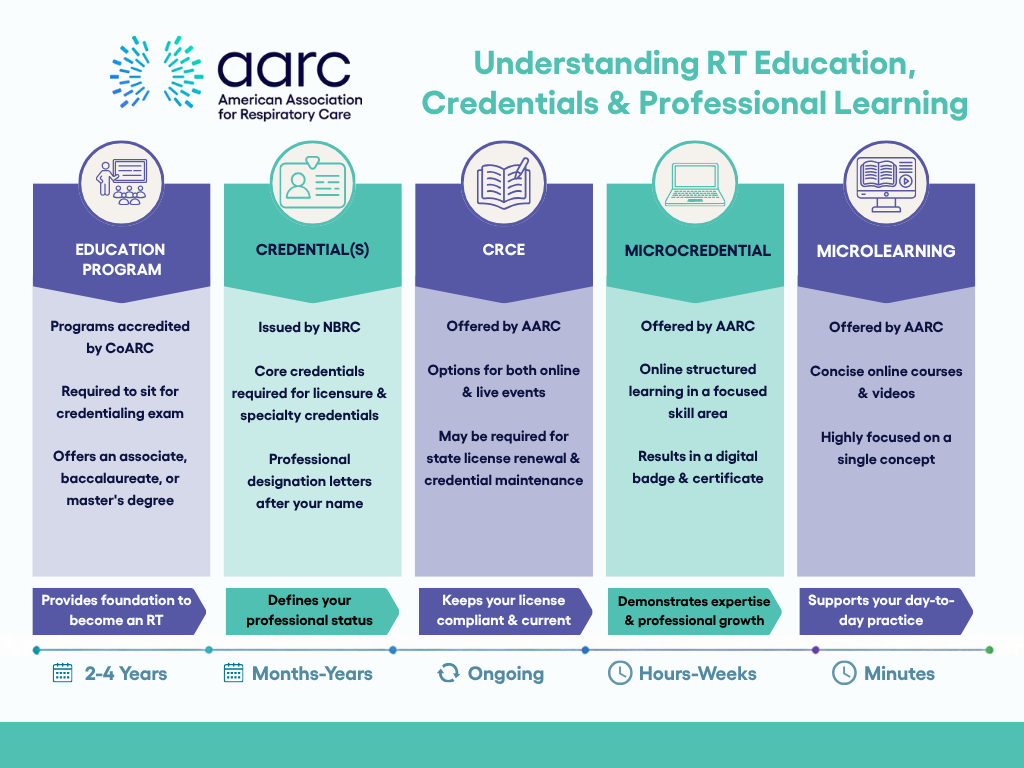
What is a Credential?
A credential recognizes successful completion of a job-related, valid competency examination. It confirms that you meet established national standards for respiratory care practice and/or advanced specializations.
Key Points
- Only activity that allows you to utilize recognized letters of a professional title (e.g., CRT, RRT, RRT-ACCS, RRT-NPS) after your name.
- Issued by a credentialing body, like the National Board for Respiratory Care (NBRC).
- Requires passing standardized national examinations.
- Validates entry-level or advanced professional competence.
- Required for licensure in all 50 states and often for employment.
What is CRCE?
Continuing Respiratory Care Education (CRCE) helps maintain your credentials and stay current in practice. It is an essential, ongoing professional responsibility.
Key Points
- Approved continuing education for respiratory therapists
- Required to maintain state licensure and credentials
- Earned through courses, conferences, webinars, and other activities
- Focused on maintaining and updating clinical knowledge
- Measured in credit hours
- Does not result in new credentials or title designations
What is a Microcredential?
A microcredential recognizes demonstrated competency in a focused area of practice. It validates specific skills and knowledge but is not a professional designation, certification, or credential.
Key Points
- Structured learning pathway with an assessment, typically renewed every three years
- Demonstrates competency in a specific skill, topic or speciality
- Are designed to complement credential, not replace it
- Does NOT include title designations (no letters after your name)
- Results in a digital badge and a certificate of completion
- Help individuals stand out to employers as they showcase continuous learning, and skills in emerging or high-need areas
What is Microlearning?
Microlearning supports daily practice at the bedside by helping you quickly refresh or build knowledge. It’s often used alongside formal CRCE and microcredential pathways. Microlearning does not qualify for CRCE credits.
Key Points
- Short, focused learning
- Typically 5 to 10 minutes
- Quick knowledge refresh

